

How Teens Develop Artistic Voice With Practice
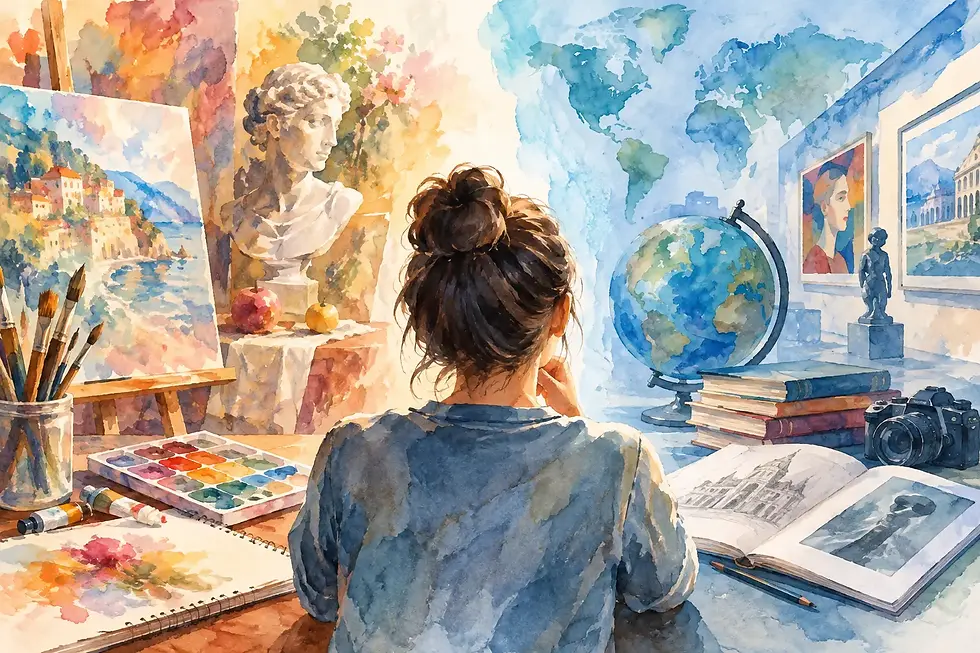
A teen may spend weeks drawing a realistic eye, then suddenly fill a sketchbook page with distorted faces, unusual colors, or images from a favorite game. That shift is not a distraction from serious art training. It is often part of how teens develop artistic voice: they begin connecting technical skill with their own interests, experiences, questions, and point of view.
For parents, artistic voice can sound abstract compared with measurable skills such as perspective, shading, composition, or digital drawing. In practice, the two are closely connected. A student needs enough command of materials to make choices on purpose. As skills grow, a teen can move beyond asking, “Can I draw this?” and begin asking, “What do I want to say with this?”
Artistic Voice Is Built, Not Discovered Overnight
Artistic voice is the recognizable set of choices an artist makes. It may appear in subject matter, color relationships, line quality, composition, materials, mood, or the ideas behind a series of work. It does not mean every piece must look the same. A strong voice can evolve while still feeling intentional.
Many teens worry that having an artistic voice means inventing a style no one has seen before. That is an unrealistic standard, especially early in their development. Young artists learn by observing, studying, and sometimes borrowing approaches from artists they admire. The goal is not to avoid influence. The goal is to understand what attracts them to an influence, then make choices that become increasingly personal.
A student might be drawn to graphic novel inking because they enjoy clear storytelling, watercolor because they value atmosphere, or detailed realism because they notice small visual differences others miss. Over time, those preferences become clues. With professional guidance, the student learns to turn those clues into stronger artistic decisions rather than isolated experiments.
Technical Skills Give Teens More Ways to Speak
Self-expression is most powerful when a student has the skills to carry an idea through. A teen who wants to create a dramatic portrait needs to understand proportion, light, value, color, and composition. A student interested in character design benefits from anatomy, gesture, perspective, and visual storytelling. Someone making digital art still needs foundational drawing skills, even when the software provides helpful tools.
This is why structured instruction matters. Technical exercises may not always feel as exciting as creating a finished personal piece, but they give students range. Learning to control graphite, paint, ink, collage, or digital brushes helps teens select a medium because it serves their concept, not simply because it is familiar.
Skill-building also teaches productive problem-solving. When a composition feels flat or a painting loses focus, students can identify why and revise it. That ability builds confidence. Instead of abandoning a difficult work, they learn that artists improve ideas through process, observation, and persistence.
Copying Can Be a Learning Tool, Not a Final Destination
Teens often begin by recreating favorite characters, online art trends, photographs, or the work of artists they admire. This can be useful practice when handled thoughtfully. Copying teaches students to notice line weight, shape language, rendering methods, and compositional choices they may not yet recognize on their own.
The next step is essential: transformation. A teacher can ask, “What would change if this character had your story, your setting, or your color palette?” A student may combine an admired visual approach with memories of family traditions, local landscapes, music, sports, science fiction, or a social issue that matters to them. The work begins to move from imitation toward interpretation.
How Teens Develop Artistic Voice Through Meaningful Projects
One-off assignments can introduce techniques, but a sequence of connected projects helps students see their own patterns. A teen who creates several works around identity, movement, environmental change, cultural memory, or imagined worlds has more opportunity to refine an idea and make deliberate choices.
A strong project begins with a question rather than a decorative result. Instead of deciding to paint “something pretty,” a student might ask how color can show the feeling of moving to a new school, what objects represent their family history, or how an ordinary room changes when seen through the lens of anxiety or excitement. The question gives the artwork direction without limiting creativity.
Sketchbooks are especially valuable at this stage. They give teens a private space to test thumbnails, collect references, write observations, and make imperfect studies. Not every page needs to be portfolio-ready. In fact, the willingness to make rough, unsuccessful attempts often leads to the most original work later.
Constraints can help, too. A student may work with only three colors, build a composition from personal photographs, create a series using a single repeated symbol, or explore one subject in several media. Limits reduce the pressure of endless options and encourage deeper thinking. It depends on the student: some teens need more freedom to explore, while others grow when an instructor gives a clear creative framework.
Feedback Helps Students See Their Own Choices
Teen artists need encouragement, but vague praise alone does not help them grow. Saying “That is beautiful” can feel supportive, yet specific feedback teaches students what is working and what they can develop next. Comments about focal point, color contrast, symbolism, craftsmanship, or visual hierarchy give them language for discussing art with greater confidence.
Thoughtful critique should never flatten a student’s individuality. The purpose is not to make every project match a teacher’s taste. It is to help the student clarify their intention. An instructor might ask what emotion the artist wants viewers to experience, why a certain material was chosen, or whether the composition supports the main idea. These questions respect the teen as a developing artist while maintaining high standards.
Peer critique also has value in a small, well-guided class. Students learn that different viewers notice different things. They practice describing work constructively, receiving feedback without taking it personally, and revising with purpose. These are important habits for AP Art preparation, portfolio review, and future creative study.
Portfolio Development Reveals Growth Over Time
For teens preparing for advanced high school coursework or college admissions, artistic voice is not an optional extra. Portfolio reviewers want to see technical ability, but they also look for curiosity, sustained investigation, and evidence that the student can develop an idea across multiple pieces.
A portfolio should not become repetitive simply because a student has found a successful look. The strongest collections balance consistency with growth. A student may return to a theme across several pieces while changing scale, medium, point of view, or level of abstraction. That progression shows both commitment and creative flexibility.
At Expression8 Art Academy, portfolio-focused instruction can help students connect foundational training with personal project development. The goal is not to manufacture a style for admissions. It is to help each student produce work that is skillful, authentic, and supported by clear artistic reasoning.
Parents can support this process by valuing progress alongside polished outcomes. Ask a teen what they were trying to communicate, what reference material they used, or what they would change in a second version. Display finished work, but also respect the sketchbooks and experiments behind it. Avoid pushing a student to make only the kind of art that seems marketable or familiar. Admissions goals matter, yet a portfolio becomes more persuasive when it reflects genuine engagement.
Give Voice Time, Structure, and Room to Change
Artistic voice rarely appears as one dramatic breakthrough. More often, it develops through repeated practice, close observation, honest feedback, and the freedom to revise. A teen may change interests several times, and that is not a lack of direction. It is evidence that they are testing what matters to them.
The most valuable environment combines warmth with expectations: room to experiment, instruction that strengthens fundamentals, and guidance that asks students to think more deeply about their choices. When teens are given that balance, they do more than make attractive artwork. They learn to trust their perspective and give it a clear visual form.


Comments